


Human-Nature: supporting mental health by connecting people with nature
10th October 2019
There has been a wealth of research in recent years on the benefits that exposure to nature can have on mental health. The World Health Organisation defines mental health as:
“A state of well-being in which (an) individual realises her or his own potential, can cope with the normal stresses of life, can work productively and fruitfully, and is able to make a contribution to her or his community”.
Here at Outerspace we are driven by the concept of supporting “Human-Nature”, designing open space to balance the needs of humans with the needs of the natural environment in a mutually beneficial way.
Indeed the experience of nature by humans is closely connected to psychological well-being, with a positive effect on social interactions, sleep quality, happiness, a feeling of meaning and purpose in addition to a decrease in feelings of stress and anxiety. Repeated studies taken over longer periods of time have also shown nature experience to positively affect attention, memory, creativity and educational performance.
Furthermore from a financial perspective, a ‘natural capital account’ produced by Vivid Economics, The GLA, The National Trust and HLF calculated mental health benefits account for 7% of the total economic benefits of London parks.
Mental health and urban living
We are living through a period of rapid global urbanisation and the majority of our working and personal lives takes place in and around cities and large towns. At Outerspace we believe it is crucial for us to try and understand how we can contribute positively to the mental health of our stakeholders within these environments. Although cities provide employment, culture, social and educational opportunities, it is often argued decreased access to nature, increasingly sedentary lifestyles and more time spent indoors contribute to a disconnect with nature and consequently a potential decline in mental health. Moreover there are studies showing a socio-economic gradient in mental health with people in lower socio-economic groups being at a greater risk of developing mental health problems and often also having greater barriers of access to nature and public green space.
At Outerspace we strive towards improving this imbalance as best we can, by creating open space that is fully accessible and amenable to the whole community, whatever age, physical ability or socio-economic group.
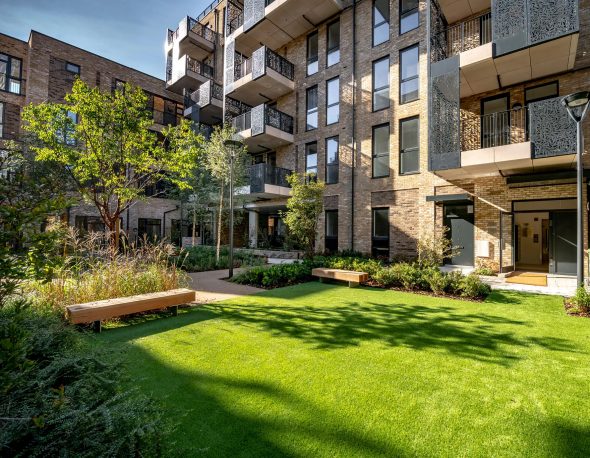
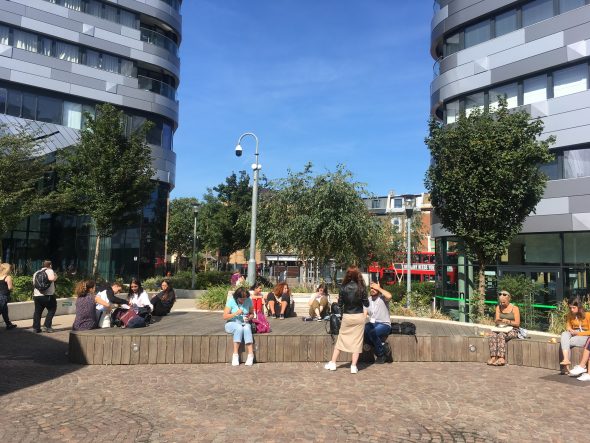
Considerations for mental health can sometimes be an explicit part of our design brief, for example designing hospitals or care homes. However it is less explicit or ignored in the other sectors such as large high density residential developments and thus we have to take the initiative ourselves. Here we see it as our role to design open space to support opportunities for well-being, catering for relaxation, socialisation, biodiversity, and play by creating access to nature either visually or physically.
Enabling communities in sustainable place-making
At Outerspace we believe that stakeholder analysis is a crucial exercise in the creation of genuinely sustainable environments. Where possible we need to understand the everyday issues of the user; what are the present problems and what are the opportunities to explore. However we must be mindful of the often contrasting views towards open space that are linked to mental health and well being. A good example is that whilst some people might support a more natural and wilder setting which offers a feeling of calmness and serenity, others will find it stressful and threatening through the reduced views and lack of cleanliness and order.
The preferred design solution also has relationships to social and environmental issues such as personal life circumstances, demographics or crime rate in an area. How safe someone feels in a space has a strong effect on how that space can positively contribute to their mental health.
Human-Nature: moving forward
The fact that there are so many direct and indirect factors to consider makes it very difficult to draw general conclusions on designing to support positive mental health in open space. Therefore as landscape architects we must always use careful site and stakeholder analysis to understand specific issues, whilst maintaining a consistent approach looking to maximise the connectivity of humans with nature in the most appropriate way. In this respect we strive to maximise the value of open space, environmentally, socially and economically.
Written by Matt Ellins, Senior Landscape Architect