Can a well designed hospital garden improve the patient experience?
5th February 2020
Yesterday was World Cancer Day. This is a day for everyone around the world to come together and unite in support of the positive, inspiring global work against cancer and its effect on the lives of so many.
Sitting in the Outerspace office and chatting about our friends and family it is evident that we have all been touched by cancer one way or another. As such we are in awe of the health professionals, carers and researchers who work, day in and day out, to find better treatments with the aim of saving lives and improving quality of life for all those affected.
With health at the forefront of our minds this week we would like to discuss how well thought out landscaping can play a small part in making hospital and hospice stays better for those in need.
A little bit of history
The belief that nature can be of benefit to those who are ill has been around for thousands of years. During the middle ages monasteries created beautiful gardens aimed at soothing those receiving treatment (Gierlach-Spriggs et al., 1998) and hospitals in the 1800s commonly contained gardens and plants as prominent features (Nightingale, 1860).
As medical science advanced, infection reduction took on more prominence and space was needed for new technologies. Slowly but surely gardens began to disappear. Over time hospitals started to become purely functional and, according to Ulrich (1991) and Horsburgh (1995), unsuited to the emotional needs of patients, their families and the healthcare staff who work within them.
In recent years a renewed interest in the holistic needs of patients and their families has emerged with a growing body of research demonstrating that stress and psychosocial factors can significantly affect patient health outcomes.
But can hospital gardens improve clinical outcomes?
The research suggests they can certainly play their part. By fostering access to social support, providing privacy not always available on busy wards and providing opportunities for escape from oppressive clinical settings, hospital gardens can play a key part in patients wellbeing (Ulrich, 1999).
Furthermore Marcus and Barnes found that more than two-thirds of people choose a natural setting to retreat to when stressed. “Let’s be clear,” Cooper Marcus says. “Spending time interacting with nature in a well-designed garden won’t cure your cancer or heal a badly burned leg. But there is good evidence it can reduce your levels of pain and stress—and, by doing that, boost your immune system in ways that allow your own body and other treatments to help you heal.”
So much more to the design than ‘just a garden’
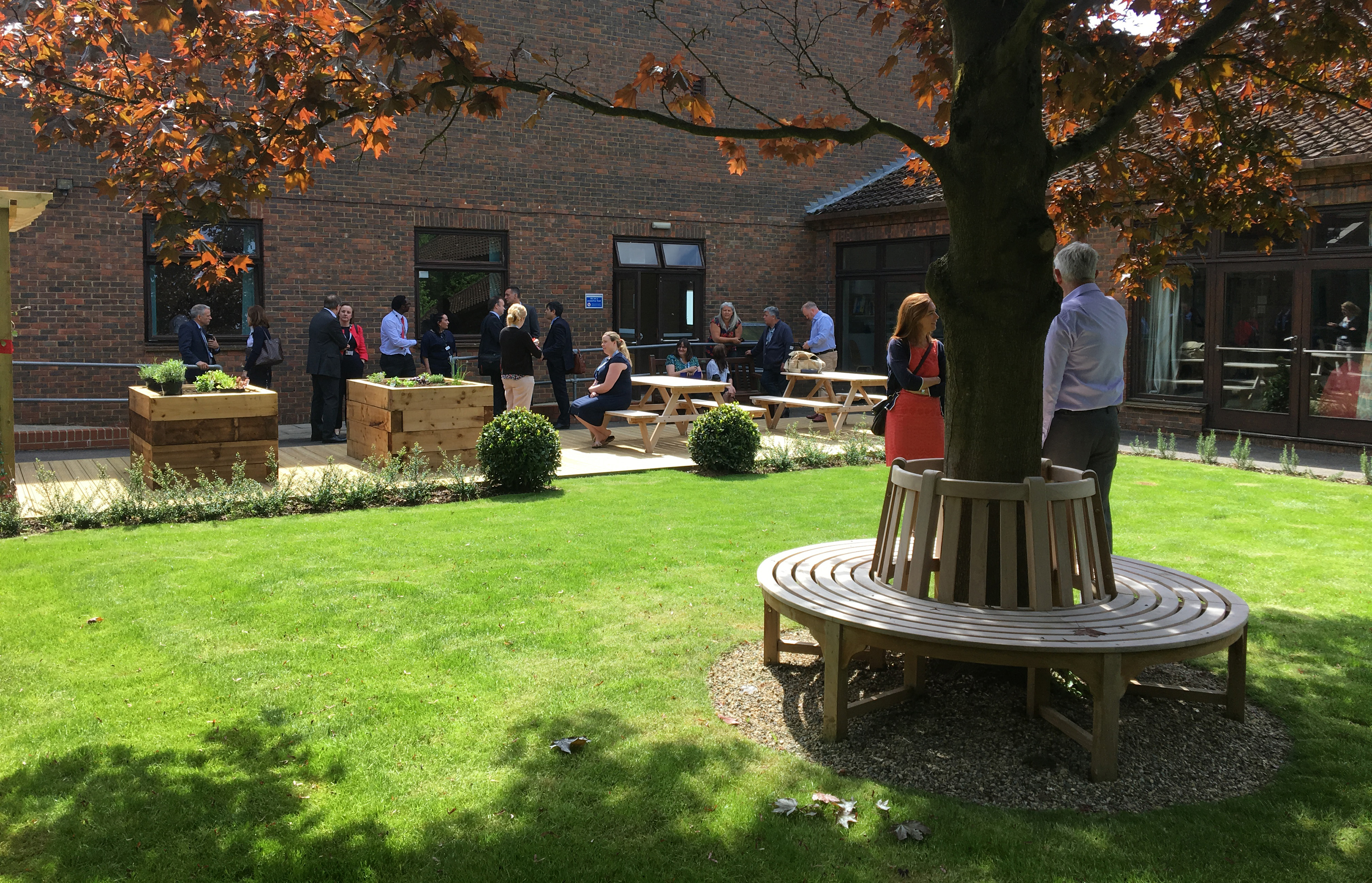
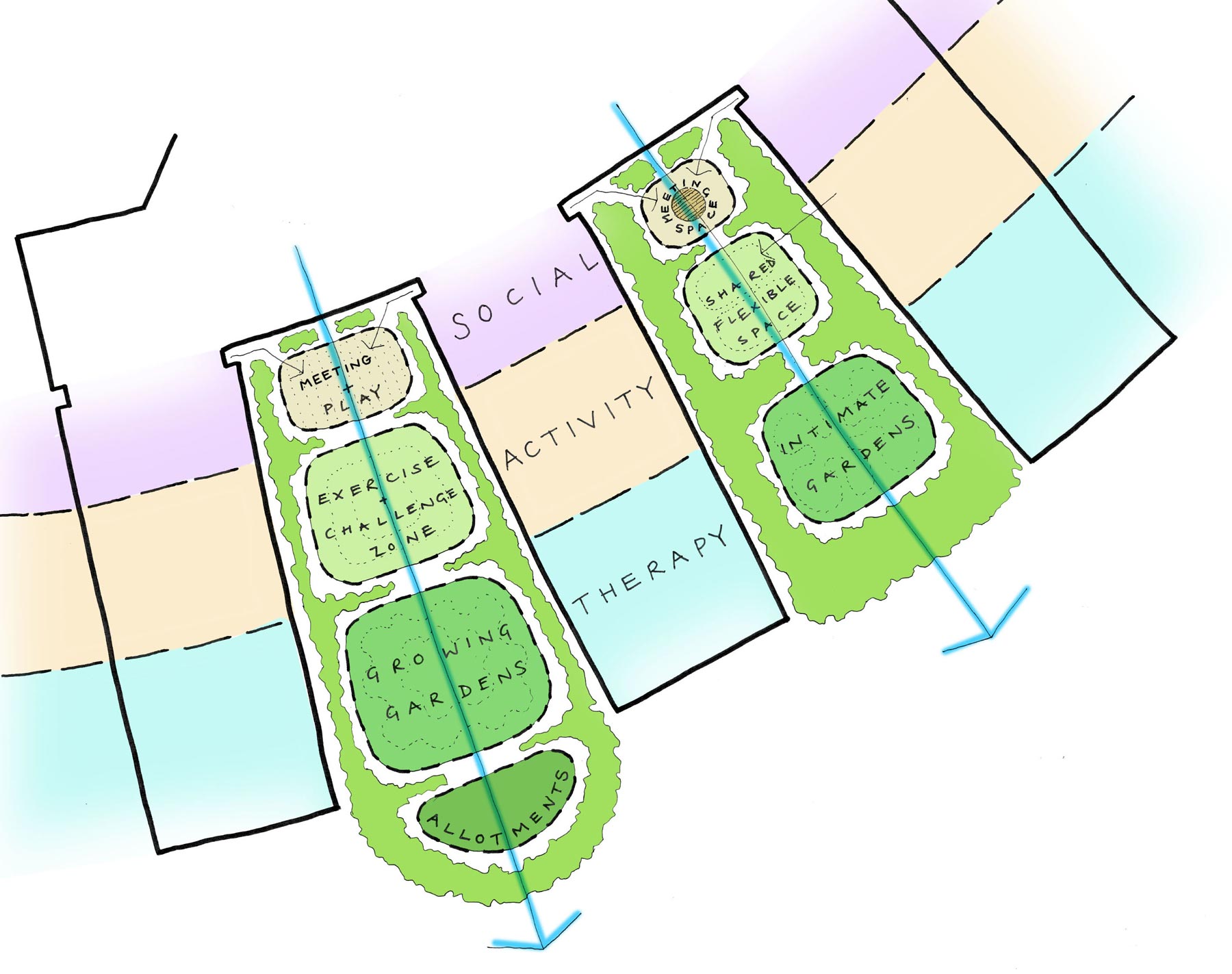
If you have never designed a landscape before we could forgive you for thinking that creating a therapeutic garden would be relatively simple, however research tells us that what a patient can do in the garden is as important as what they see. The results of “behavioural maps” tracking visitors’ actions while in a garden suggested a need for secluded areas where people can hold private conversation; smooth, tree-lined paths that invite patients to amble but that will not trip wheelchairs or catch intravenous poles and practical furniture that is lightweight and moveable so it can be repositioned into the shade or sun as required. However, the most important feature in a healing garden is real nature-green vegetation; naturalistic landscaping that lures birds, squirrels and other wildlife.
We can learn about how best to design gardens for caring settings by looking at many different conditions. One of the most studied conditions, when considering the link between disease to garden design, is Alzheimer’s disease and other forms of dementia. The design elements that appear particularly beneficial include simple looped pathways, because patients typically have impaired way-finding abilities and dark or tinted walking surfaces, because glare troubles ageing eyes. Evaluations indicate that these gardens improve quality of life for patients, afford an opportunity for them to exercise without becoming agitated, and lighten the burden of care for nurses.
Sadly, many opportunities to make gardens available have been wasted. For example, in the UK, courtyards at some new hospitals set up under the private-finance initiative are minimally planted, and their doors are kept locked. There seems to be limited recognition among NHS officials, hospital architects, and private-finance clients that outdoor spaces can be important restorative settings.
Looking to the future
At Outerspace we believe that the opportunity to create a garden can exist in the most unlikely of places. Hospitals are a rabbit warren of internal and external walkways and courtyards which can be transformed with knowledge, research, care and attention. Landscape Architects, with knowledge of plants and the design of healing gardens, should be hired to create them, and environmental psychologists should be enlisted to help assess their effects so we can use learning to continue to create the most beneficial environments possible.
Outerspace have had the pleasure of creating a number of gardens for healing environments. Please do take the time to visit them on our website:
- Acute Therapy Garden, St Peters Hospital
- Queen Elizabeth Foundation, Leatherhead
- Royal National Orthopaedic Hospital, Stanmore
We would like to end this blog, not with the words of someone at Outerspace, but with the words of a patient at St Peters Hospital, who wrote a poem as a thank you for the work we did. Here’s a small extract:
For you a summer shower and a glint of light
So brush away the cobwebs from the harbours of your fright
The lavender hedge with glisten as you sip your herbal tea
A robin and wagtail with nestle in the crutches of that tree
So drown away those demons and think only of joy
Then your summer sunshine will bathe within
The heart of that little boy!
Written by Kate Kershaw, Practice Manager