


Designing for Dementia
20th September 2024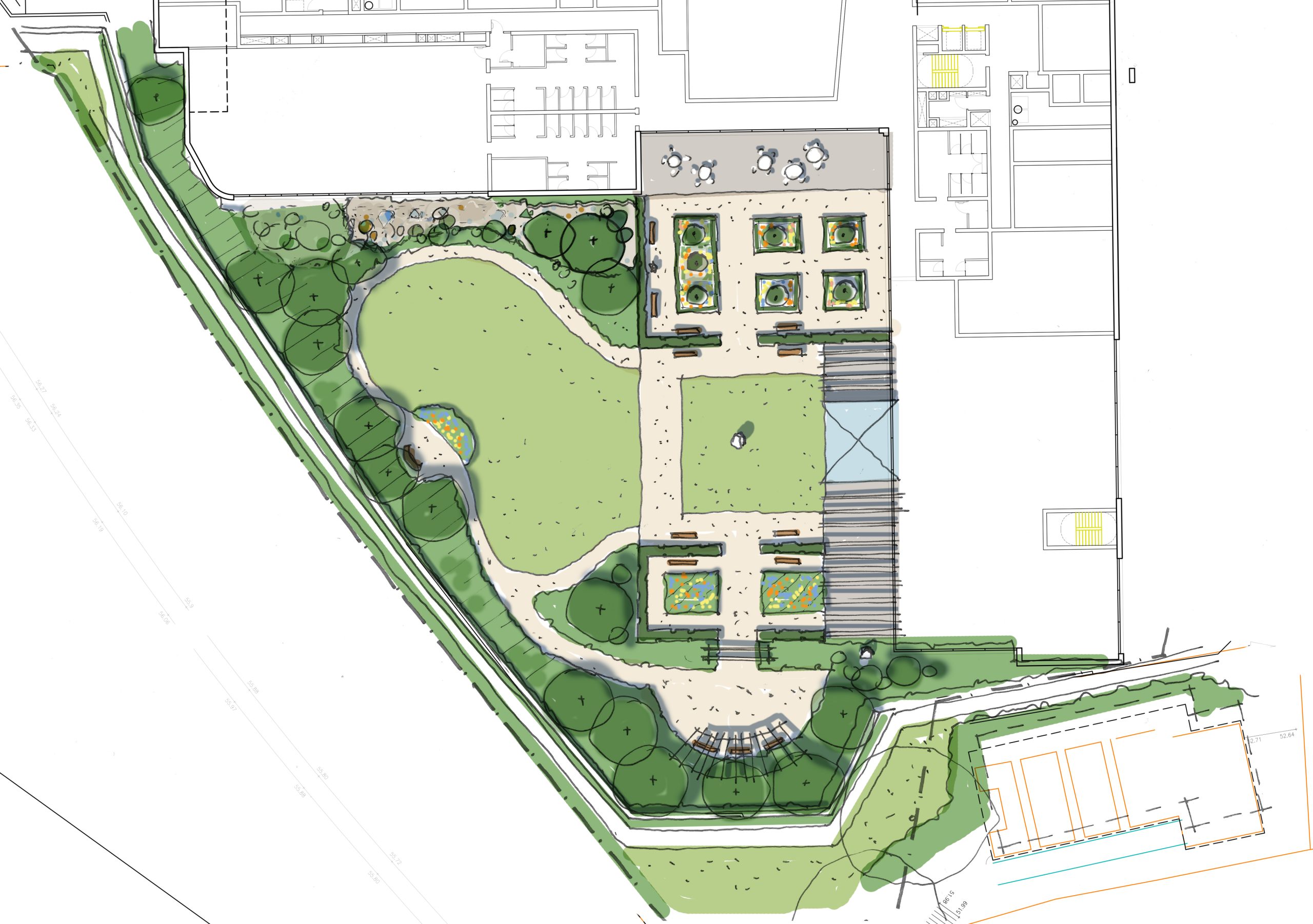
As we acknowledge World Alzheimer’s Day, on the 21st September 2024, we at Outerspace have paused to reflect on our approach to our landscape designs when designing gardens and open spaces for people living with a variety of dementia diseases.
As we all know, there is a wealth of research noting the benefits we all see from connecting ourselves with Nature. Not least for people living with a variety of dementia diseases or that require assisted living facilities. Nature can not only be healing for the mind and body, but also bring joy and hope through engagement with garden activities.
As Landscape Architects we can help to extend the length of time people with dementia can continue to interact with the outdoor world by Designing for Dementia.
What is Designing for Dementia?
One of the first barriers that people living with dementia face is the attitudes of others. Room and care services are often considered but little thought is put into the stimulation provided by the external environment. Having a safe place, with clear boundaries, lighting and signing is essential. People need to be able to get outside and interact with nature in a safe, secure way. Dementia living stimulation cannot be provided through TV and internal activities alone. As much as safely possible, people with dementia must be enabled to live the life they were living prior to their diagnosis. Zeisel (2004) stated that “Every environmental characteristic that helps people with dementia be more “themselves” helps unleash hard-wired brain capacities that reinforce a person’s sense of self, which improves reciprocal relationships between the person and their partners and caregivers.”
Thus, we feel the quality and experience of the external space in care and assisted living schemes is crucial to the lives of the residents, staff and visitors. Here at Outerspace we believe that the landscapes should be the following:
- Accessible and inclusive. They must be designed to accommodate residents with mobility challenges, cognitive challenges and other disabilities. Safety in the landscape is of paramount importance; A secure boundary can ensure that someone living with dementia can’t wander off and get lost, without making them feel ‘shut away’. Pathways should be wide enough for someone to make a ‘U-turn’ comfortably, and, if required, signs can be used to clearly mark out return routes. Pathways should be as level as possible with steps and sharp slopes avoided. Poisonous plants should not be easily reachable and areas of water should be made secure.
- Varied and stimulating sensory experiences. This can be achieved through the use of different plants, textures, scents, and colours. Dementia is very individual to each person and how the senses will be impacted is difficult to predict. Creating a landscape that stimulates the senses should can be considered. Think of how to incorporate plants with different colours and textures, trees that will rustle in the wind and attract birds and insects, flowers that give off different scents. All of these elements can be brough into landscape design to make the outdoor environment a more enriching one for a person living with dementia.
- Thoughtfully designed seating areas to provide opportunities for rest, relaxation, socialization, and contemplation. Older people can become more sensitive to weather changes. Sufficient shelter can protect them from the wind and rain and shade them from the sun. Well thought out seating design and placement can also provide places to rest or places to observe the environment in a more passive way.
- Safe pathways with non-slip surfaces and adequate lighting for residents to navigate independently, even at night. When someone is living with dementia the world can feel confusing and fear of getting lost can create isolation. Creating a landscape with a single or simple route around it can help to reduce this. Keeping the landscape as level as possible with clear sightlines for returning home and having a route that’s easy to navigate is hugely beneficial and will help people feel safe and calm. For night time, well placed and bright lighting can reduce trips and falls as well as reduce fear.
- Integration of therapeutic elements such as raised garden beds for residents to engage in gardening activities, promoting physical activity and mental well-being. For many of us, bending down gets harder with age, this can be magnified for those living with dementia if spatial awareness is effected. Creating a design which incorporates raised planters can reopen the natural environment to those with dementia, and those that require assisted living facilities, reconnecting them with nature.
Case Study: Mayfield Retirement Village
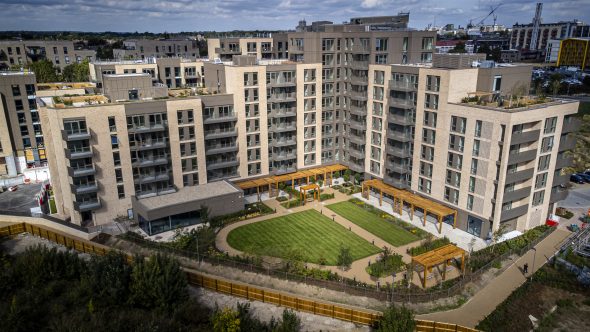
Our case study project below is the completed Mayfield Village in Watford on behalf of Audly.
Whilst this scheme does not specifically have care for people living with Dementia, the external landscape sought to promote the above principles which are still highly relevant to senior living in general:
The ground floor Courtyard landscape garden
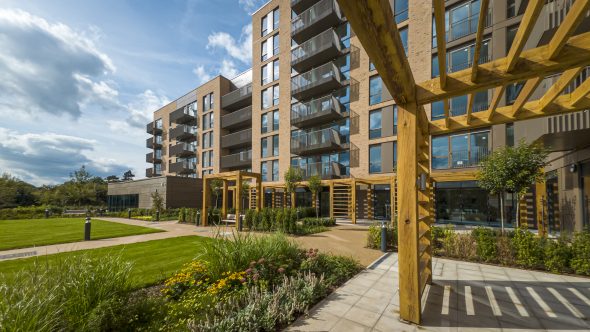
The courtyard is for residents, staff and visitors to enjoy. It provides beautiful views for residents to look out on and an informal recreational area allowing for a small sanctuary garden within. The theme of the rear landscape is an English Countryside Garden with a contemporary twist, where formal gardens and terraces are offset by serpentine routes with more naturalistic/sensory planting and the inclusion of follies.
The communal terraces are surfaced with high quality concrete paving and are an extension of the Village Hall & Residents Lounge and restaurant. It is used for small scale outdoor seating and dining looking outwards onto highly ornamental flowerbeds and a formal lawn area including a small central feature/ sculpture. A series of small formal garden rooms alongside the outdoor terraces invite for rest and contemplation as well as socializing. The garden rooms are framed and separated by low- height clipped hedges whilst a formal axial route connects the rooms towards a semi-circular pergola and curved benches as well as a meandering path which invites for a stroll.
The upper terraces
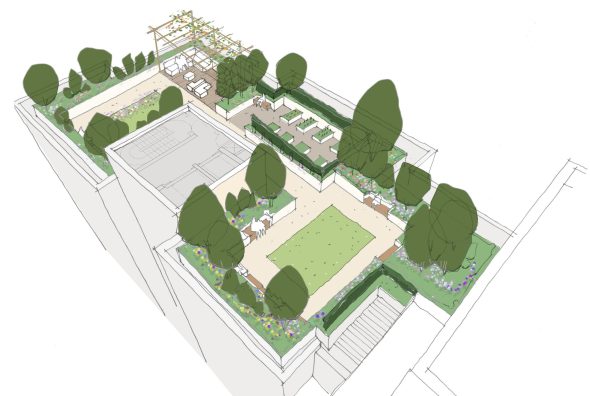
The roof terraces offer accessible raised planting beds. These can be planted and maintained by the residents and offer joy and hope through the engagement of garden activity. The upper terraces also offer pergola sheltered seating areas for the opportunity to pause, relax, contemplate and socialize.
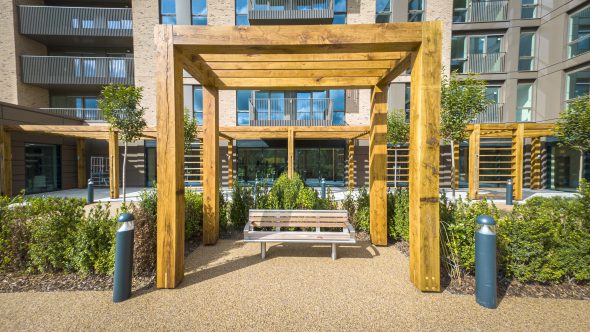
Our design allows for a good pedestrian flow of movement whilst creating smaller areas where people can sit back and relax on a bench, alone or together. Garden visitors can enjoy ornamental planting beds from close to offer a sensory experience. Together the landscape composition provides both a lush green setting and a garden to look out on to and/or explore throughout the seasons.
In summary, we at Outerspace feel it is paramount to include such aims as above when designing spaces for people with Alzheimer’s as well as other Dementia diseases, and people with any other forms of illness, as this allows them to feel deeply connected with Nature, thus allowing people to feel joy, nourished and calm.