


Women in BIM – The experience of a Landscape Architect in the world of BIM
16th December 2024
My curiosity about BIM began four years ago when I first ventured into the world of Revit, a software that has become increasingly integral to the projects at the company I work for. I recognised an opportunity to not only expand my own knowledge but also to explore new possibilities in our workflows. BIM was beginning to emerge as a cornerstone of our daily work, demanding attention and adaptation.
Networking has been instrumental in this journey. Attending the London Build Event last year proved to be a pivotal moment. A panel discussion on Women in BIM (WiB) introduced me to the mentoring scheme, which immediately piqued my interest. Driven by curiosity and a desire for growth, I seized this opportunity to join the programme.
Participating in the Women in BIM mentoring scheme has been a transformative experience in my professional development. Guided by Francesca Lofiego, my mentor, I explored complex topics, gaining clarity on BIM processes and their relevance to the evolving construction industry. Our monthly sessions provided invaluable insights into the roles and responsibilities of consultants and contractors within the AEC (Architecture, Engineering, and Construction) sector, particularly in the context of BIM standards and workflows.
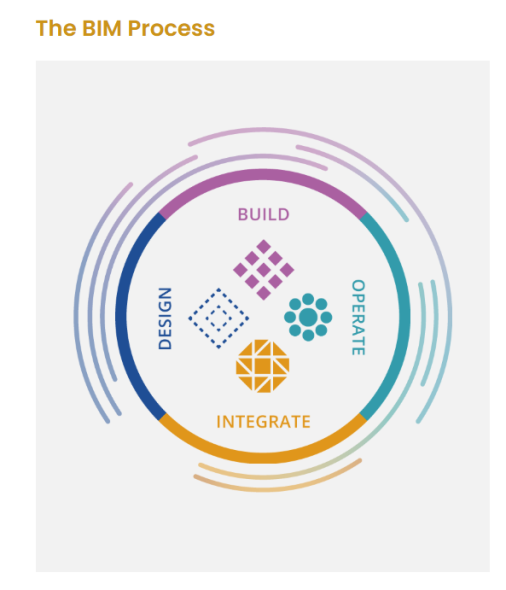
Diagram of the BIM Process – Reference: UK BIM Framework
We frequently discussed the importance of coordination in BIM processes, particularly in relation to the landscape architecture sector, which still faces significant challenges in adopting BIM workflows effectively. Tools such as Revit, Autodesk Tandem, OpenSpace, and BuildIT were examined, highlighting the financial and functional constraints that limit adoption. Francesca emphasised the value of collaboration across disciplines to overcome these barriers, particularly within the framework of ISO 19650 standards.
Francesca also explained the transition from UK-specific standards (BS 1192 and PAS 1192) to the internationally recognised ISO 19650 standards. These provide consistency and improved workflows but present challenges in aligning with existing processes.
A significant portion of our discussions centred on the Common Data Environment (CDE) and its role in facilitating seamless collaboration. Francesca explained the relationship between various Information Requirements, such as the Employer’s Information Requirements (EIR), which specifies what information is needed inside the BIM Execution Plan (BEP) which outlines the processes and actions required to deliver that information effectively. She also shed light on the importance of COBie (Construction-Operations Building information exchange) for asset management and the adoption of Uniclass 2015 for effective classification and naming conventions.
COBie, in particular, stands out as a structured digital tool that streamlines asset management. Unlike traditional handovers reliant on fragmented documentation, COBie ensures the smooth transfer of data from construction to operations, aligning with EIR to support efficient facility management systems.
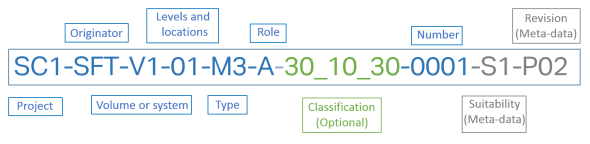
Example Summary of a Naming Convention
The landscape architecture sector faces unique challenges within BIM environments due to the limited availability of tools tailored to its specific needs. Unlike architecture and engineering, landscape projects often involve modelling complex, organic forms and integrating dynamic elements such as vegetation growth and soil systems—areas where tools like Revit currently fall short. The lack of built-in plug-ins and templates necessitates time-consuming manual adaptations, reducing efficiency.
There is hope, however, with tools like Environment, which offers advanced capabilities for landscape modelling and analysis. Moving forward, integrating such functionalities into mainstream BIM software could empower landscape architects to work more seamlessly and efficiently, unlocking the full potential of BIM in this field.
The Landscape Institute holds a critical role in shaping the future of the profession. As a member pursuing Chartership, it is evident there are still gaps in fully embracing digital tools such as BIM. However, if the institute integrates emerging technologies alongside its sustainability agenda, it can provide a more robust framework for addressing industry challenges.
Francesca’s mentorship went beyond technical guidance; it encouraged me to view challenges as opportunities for innovation. This experience inspired me to advocate for improved workflows and greater technology adoption within my workplace. It strengthened my technical proficiency and instilled confidence in my ability to contribute meaningfully to the Landscape industry.
Being a Landscape Architect in the BIM world requires not only navigating the limitations of certain tools (primarily the constraints of Revit in our case) but also managing the varying expectations for naming conventions across projects. A key challenge lies in identifying the correct volume or unique initial number specified in the BIM Execution Plan (BEP), which often differs from project to project. Additionally, adapting to the broader challenges of BIM component flexibility and the need for continuous training adds another layer of complexity. Developing customised BIM families, templates, and workflows is already a time-intensive process, further compounded by the requirement to ensure their adaptability across multiple projects. Moreover, the lack of specialised training for landscape architects forces many to rely on general BIM resources, which fail to address the specific needs of the discipline. Bridging these gaps through targeted training and more adaptable BIM tools would streamline workflows and enable landscape architects to integrate more effectively into the BIM ecosystem.
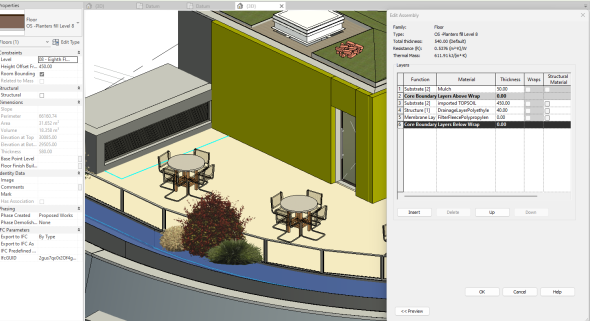
BIM Information Embedded within BIM Families
Written by Sara Sandei, Landscape Architect