


The Role of Trees in Spatial Dynamics
Those of us working in placemaking understand the many roles’ trees play in our towns and cities. They provide shade and cooling, soften wind and noise, support biodiversity and help to counter the overwhelming scale of buildings. But trees do more than provide environmental benefits. They are also powerful spatial tools, helping to shape how streets and spaces feel, function and ultimately are experienced.
Trees play a crucial role in the architectural composition of streets and spaces. Well-known urban design theories such as Gordon Cullen’s Serial Vision in Concise Townscape or Peter Smith’s The Dynamics of Urbanism, emphasize the importance of creating a clear spatial contrast between the linearity of streets and the openness of spaces. Trees need to support and reinforce this distinction.
Designing with trees starts with understanding the spirit of a place; its history, ecology, people and the small details that can easily be overlooked. It also means challenging the tick-box approach to public realm. A space can function perfectly well on paper, yet still fail to inspire, delight or invite people in. Understanding the theories of tree placement and the spirit of a place is paramount.
One of the simplest principles we return to when designing with trees is: “streets are streets, spaces are spaces.” Urban design thinking reminds us that people experience cities through movement and changing views rather than from a plan alone. Trees can reinforce this experience, creating rhythm, direction, enclosure, openness and moments of surprise.
Trees in Streets
- A single row of trees can line a pathway, separating it from a road and strengthening directionality. Repeating the same species can also bring coherence to streets where building styles vary.
- Two rows create an allée, framing a view or focal point such as a sculpture, bench or building. A double row along a road becomes an avenue, creating a stronger sense of arrival and giving a destination greater presence.
- Sometimes, less is more. Incidental planting can break up a dense street and introduce softness and relief where a formal avenue is neither practical nor appropriate.
Trees in Spaces
- In a square or plaza, a single specimen tree can become a focal point, anchoring the space and providing a human-scale moment within a larger setting. Two trees can mark an entrance and frame a view, while a perimeter of trees can define an edge without closing a space down.
- Groups of trees, or groves, offer another opportunity. Closely planted trees can create a strong focal point, while a looser arrangement can feel informal and relaxed.
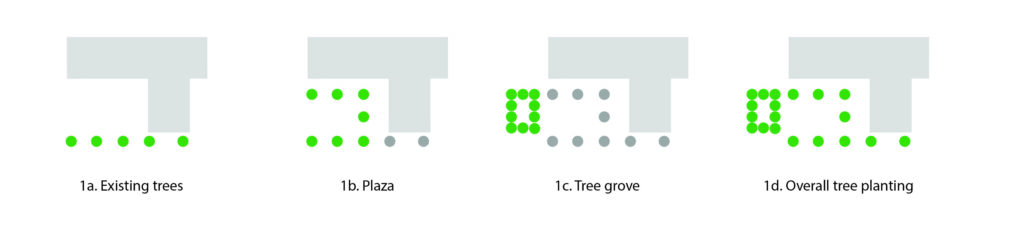
We applied these tree arrangements in our Neighbourhood Square project in Watford, creating two contrasting spaces: an open, sunny plaza and a more enclosed grove. Existing trees were retained and used as part of the spatial structure, while new planting helped soften the scale of the surrounding building and establish a clear hierarchy.
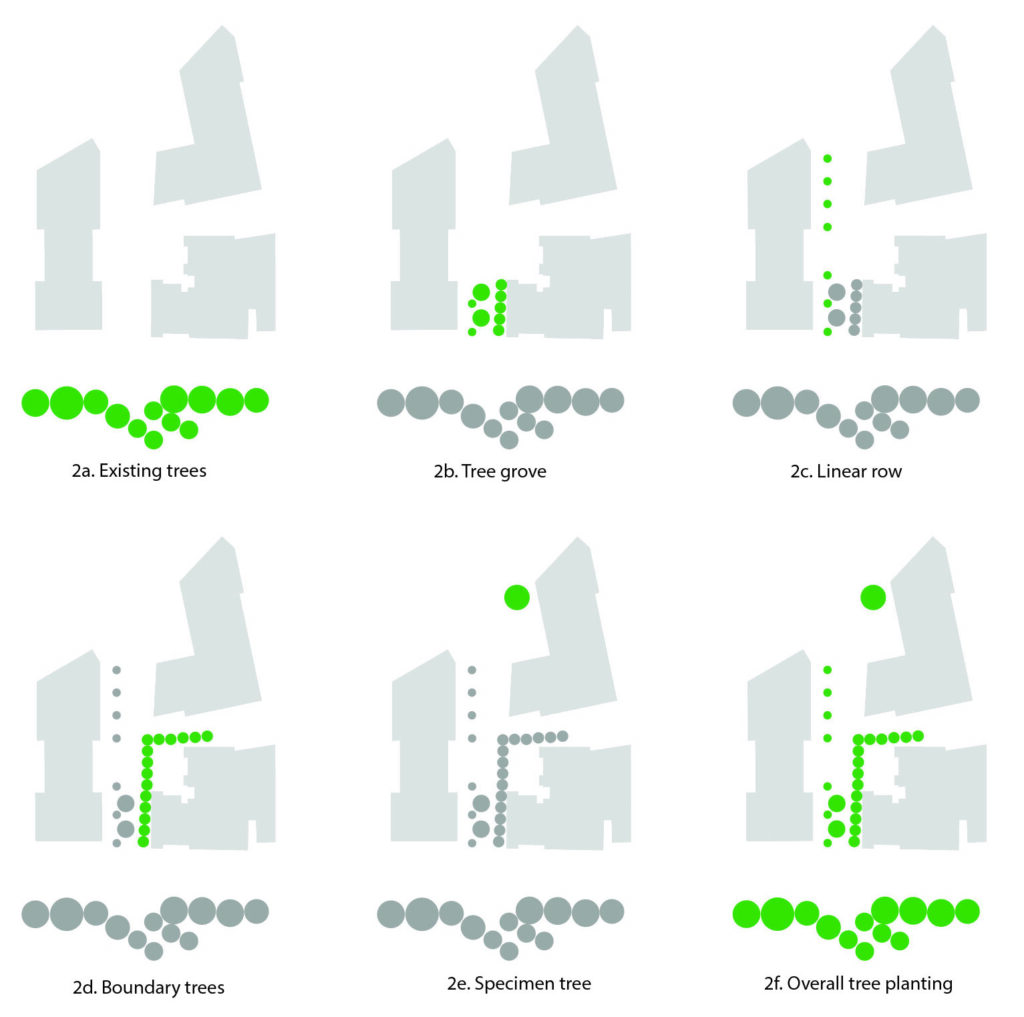
At Peel Place in London, we used trees to create a sequence of spaces that gradually become less dense towards the Market Square. A small grove welcomes people at the entrance; a linear row supports movement and visual permeability; a denser group provides screening; and a specimen tree anchors the Market Square.
For Outerspace, this is where landscape architecture becomes more than simply placing trees. We design for all the senses; considering light, shade, breeze, sound, movement and the changing character of planting through the seasons.
Outerspace care deeply about our craft and the high-quality work we design. We balance imagination with practical understanding. The goal is not to fill a plan with trees, but to use them thoughtfully to create places that spark joy, movement and community wellbeing while supporting biodiversity, sustainability and resilience. Trees are undeniably one of the primary design elements for landscape architects, and, when properly considered, provide social, environmental and economic benefits.
Ultimately, trees are not decoration. They are living pieces of urban structure; shaping identity, comfort, ecology and experience. When carefully considered, they help us make places where people and nature can flourish together, now and for generations to come.